
 English
 日本語
日本語
 한국어
한국어
 简体中文
简体中文
 繁體中文
繁體中文
 Italiano
 español
 Deutsch
 Русский


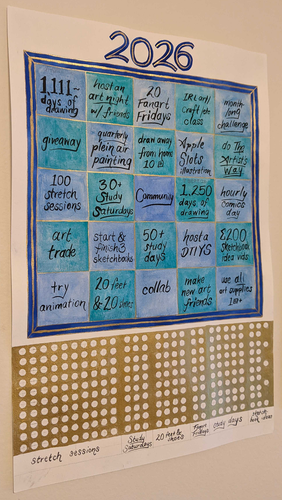
For the past 2 years, I've made myself a bingo sheet of all the art goals I'd like to complete. And so far, I've done pretty well in accomplishing it!
Here are some of the "rules" I use to balance my bingo sheet to make it not only doable but interesting and engaging throughout the next 12 months!
#1 -- Be specific!
It's important to break down larger goals. For example, "get better at drawing" is vague and isn't easy to track. But you can ask yourself, "What does 'better' mean?" For example, there are many art fundamentals like anatomy, composition, color theory, etc that you can focus on instead. If you're looking to improve your English, be specific! Do you want to understand TV shows? Speak better in presentations? Be better understood while talking to friends around the world?
#2 -- Give yourself easy wins!
On my bingo sheet for 2026, I have a few long-running goals that look really big, like 1,111 or 1,250 days of drawing. But in reality, it's a habit I've already fit into my life that I can keep up with. In addition, every other art goal helps me work towards these two milestones!
Maybe for you, it'll be helpful to give yourself quick goals, like, "Talk to a new tutor" or "Try a different kind of English lesson." Or, if you already practice English daily (or most days), try studying or using English everyday.
#3 -- Numbers are your friend!
When creating a new habit, we want to repeat it again & again. That way, it will integrate into our lives more effectively. So when I want to get better at drawing something (for example: shoes), I give myself a goal to do it a certain number of times. Though it can be a bit harder to track, it forces me to practice.
For English learners, I recommend doing something 50 times in the next year. It sounds like a lot, but it's about once a week, which is doable for most peoples' schedules! Try adding it into your weekly routine like integrating a new sport to practice. Maybe try taking 50 lessons overall next year!
#4 -- Tests give you focus and stress; they help some & hinder others
I've never made my Japanese learning goals focused on a test, since they stress me out. Additionally, testing my knowledge in a classroom setting has never been my goal. However, because of that, my goals are less easy to quantify.
But for others, tests are a great source of focus. They give a definite list of vocabulary, grammar, passages for reading & comprehension, listening skills required, and often a spoken test section. Even if you're not looking to take a test, I suggest researching what's requried. It can help you choose vocabulary or grammar to study in addition to quickly gathering reading materials. And if you're confident in your studying skills, reserve a test for the future! Having that goal can motivate you to study more often.
I recommend trying out some of my "rules" above & seeing what works best for you. Everyone's different, so their study practices should be, too!
If you'd like to work on some bingo ideas for yourself, English learning or any other goal, schedule a lesson with me! We can work on finding a good balance of ease, accomplishment, and engagement!




回应 (0)