
 English
 日本語
日本語
 한국어
한국어
 简体中文
简体中文
 繁體中文
繁體中文
 Italiano
 español
 Deutsch
 Русский


さて、今日は 場所の助詞「に・で・へ・を」の整理! English below ↓
では まずクイズです!
下の( )に 助詞「へ」「で」「に」「を」のどれが入るでしょう?
① 私は 公園( )います。
② 私は 公園( )行きます。
③ 私は 公園( )遊んでいます。
④ 私は 公園( )通ります。
こたえは・・・
↓
↓
↓
↓
↓
↓
① に
② へ
③ で
④ を
です。
下の絵は、それぞれの助詞のイメージです。
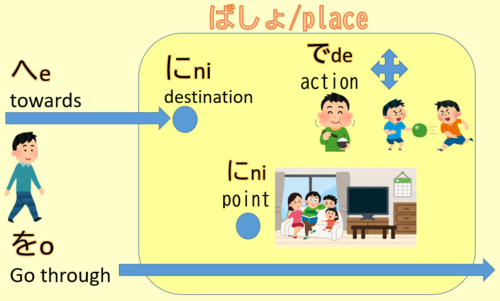
◆「へ(に)」:場所に向かう
・会社へ(に)行きます。
・家へ(に)帰ります。
・去年、日本へ(に)来ました。
※「に」は目的地、「へ」は方向のイメージです。
日常会話では「に」を使うことが多いです。
日常会話では「に」を使うことが多いです。
◆「を」:場所の中を通る
・トンネル を 通ります。
・橋 を 渡ります。
◆「に」:場所の中のポイント
・部屋 に いすがあります。
・あそこ に ネコがいます。
◆「で」:場所の中でアクションをする
・図書館 で 勉強します。
・部屋 で ゲームをします。
では、
下の A と B の文は、どんなイメージだと思いますか。
A:「公園 を 散歩します」
B:「公園 で 散歩します」
↓
↓
↓
そうですね。
A は、「公園の中を移動する」というイメージ。
B は、「公園の中で、散歩というアクションをする」というイメージです。
でも、日常会話では
「公園 を 散歩します」
「公園 で 散歩します」
のどちらも よく使います。
なので、
◎「を」=移動する場所
◎「で」=行動する場所
というイメージで覚えておくといいかもしれません。
★最後にクイズ★
( )の中に入る助詞はどれでしょう?
皆さんは、いつも どこ( )カフェトークのレッスンをしますか。
それでは またね!
******************************
◆「で (de)」— An action inside a place
Now, what is the difference?
A: こうえん を さんぽします。(Kōen O sanpo shimasu.)
******************************
Today, let’s organize four Japanese location particles:
に (ni), で (de), へ (e), and を (o)!
に (ni), で (de), へ (e), and を (o)!
★First, a quiz!★
Which particle fits in the blanks?
① わたしは こうえん( )います。
(Watashi wa kōen ( ) imasu.)
② わたしは こうえん( )いきます。
(Watashi wa kōen ( ) ikimasu.)
③ わたしは こうえん( )あそんでいます。
(Watashi wa kōen ( ) asonde imasu.)
④ わたしは こうえん( )とおります。
(Watashi wa kōen ( ) tōrimasu.)
Answers…
↓
↓
↓
↓
↓
↓
① に (ni)
② へ (e)
③ で (de)
④ を (o)
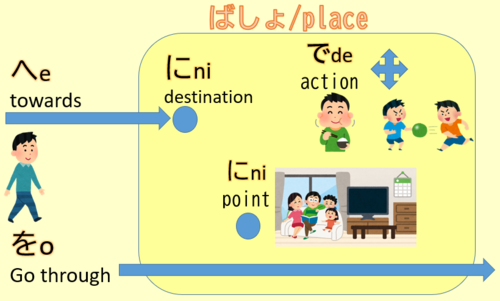
◆「へ (e) / に (ni)」— Moving toward a place
・かいしゃ へ(に)いきます。 (Kaisha E (ni) ikimasu.)
→ I go to the office.
・いえ へ(に)かえります。(Ie E (ni) kaerimasu.)
→ I go home.
・きょねん にほん へ(に)きました。(Kyonen Nihon E (ni) kimashita.)
・きょねん にほん へ(に)きました。(Kyonen Nihon E (ni) kimashita.)
→ I came to Japan last year.
※「にni」 emphasizes the destination, while 「へe」 emphasizes the direction.
In everyday conversation, Japanese people usually use 「に」 more often.
◆「を (o)」— A place you pass through
・トンネル を とおります。(Tonneru O tōrimasu.)
→ I go through the tunnel.
・はし を わたります。(Hashi O watarimasu.)
→ I cross the bridge.
◆「に (ni)」— A point inside a place
・へや に いす が あります。(Heya NI isu ga arimasu.)
→ There is a chair in the room.
・あそこ に ねこ が います。(Asoko NI neko ga imasu.)
→ There is a cat over there.
◆「で (de)」— An action inside a place
・としょかん で べんきょうします。(Toshokan DE benkyō shimasu.)
→ I study at the library.
・へや で ゲームをします。(Heya DE gēmu o shimasu.)
→ I play games in my room.
Now, what is the difference?
A: こうえん を さんぽします。(Kōen O sanpo shimasu.)
B: こうえん で さんぽします。(Kōen DE sanpo shimasu.)
↓
↓
A: 「こうえん を さんぽします」
↓
A: 「こうえん を さんぽします」
This gives the image of moving through the park.
B: 「こうえん で さんぽします」
This focuses on doing the activity of walking in the park.
In everyday conversation, both expressions are very common, so it may help to remember:
◎「を」 = the place you move through
◎「で」 = the place where you do an action
★ Final Quiz ★
Which particle fits here?
みなさんは、いつも どこ( )カフェトークの レッスンをしますか。
(Minasan wa, itsumo doko ( ) Cafetalk no ressun o shimasu ka?)
See you next time! :)
The answer to the final quiz:
どこ で カフェトークのレッスンをしますか。
(Doko de Cafetalk no ressun o shimasu ka?)
→ Where do you usually teach/take your Cafetalk lessons?




MiyoshiK
Jun 18, 2026
よければ コメントもお気軽にどうぞ~