今日のテーマは 助詞の 「は」と「が」! English below ↓
はい、では恒例の
★クイズタイム!★
絵を見て答えてくださいね!
下の ①と② に「は」か「が」を入れてみましょう :)
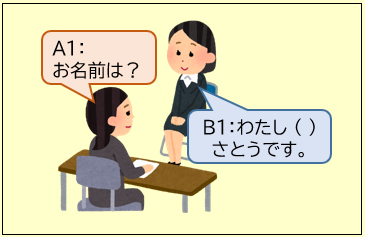
会話1
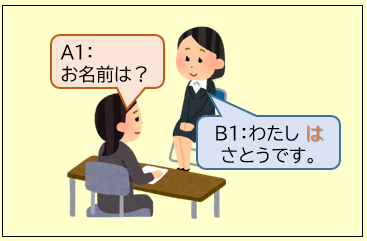
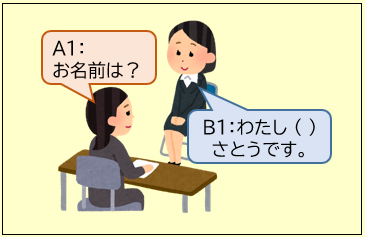
A1:お名前は?
B1:私(①)佐藤 です。
会話2
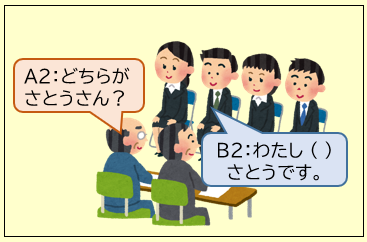
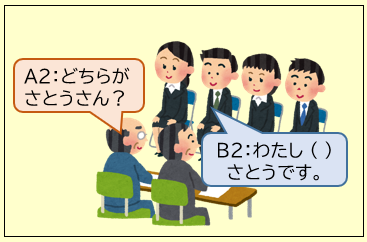
A2:どちら が 佐藤さんですか。
B2:私 (②)佐藤 です。
答えは
↓
↓
↓
↓
↓
① は
② が
です。
できた人は すばらしい!
「は」と「が」、なかなか 難しいですよね。
では、1つずつ、説明しましょう。
「は」と「が」は いろいろな 使い方がありますが、
今日は そのうちの1つを 説明しますね!
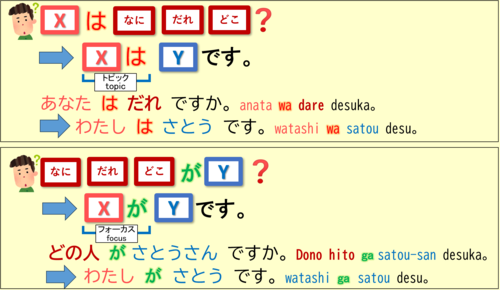
下の絵が、「は」と「が」の 違いのイメージです。
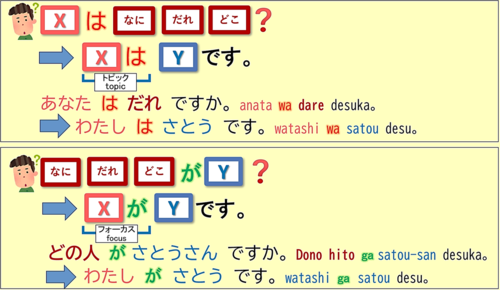
① 「は」
この「は」“話題 (わだい) /トピック”の「は」です。
話し手と聞き手が、どちらも“トピック” にしていることを話すとき、
「は」
を使います。
A1さんが “ B1( A1にとっての あなた)” について聞いたので、
この会話のトピックは “ B1(B1にとっての 私) ” です。
だから、B1さんは トピックの「は」を 使います。
_____________________
② 「が」
この「が」は “フォーカス” の「が」です。
一番簡単な覚え方は、疑問詞の後ろは絶対「が」です。
「は」を使うことはできません。
例えば、
○ 何が、どれが、どこが、どの人が、誰が・・・など
× 何は、どれは、どこは、どの人は、誰は ・・・など
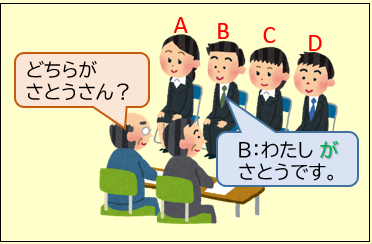
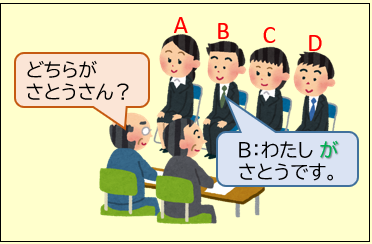
また ② の 状況では、A・B・C・D の 4人の人が いる状況で、
Bさんが、“私” にフォーカスしてほしいと言いたい状況です。
“佐藤”は、Aではない、Cではない、Dでもない、
“私(B)だ” と言いたいので、「が」を使っています。
「は」と「が」は 他にも 使い方が ありますが、今日は
● トピック の「は」
● フォーカス の「が」
について説明しました。
では最後に
★確認クイズ★
A:だれ(①)この おもしろいコラムを 書いているんですか。
B:このコラムを 書いている人(②)Miyoshiさんですよ。
A:カフェトークの日本語の先生ですか。
B:はい、その人(③)Miyoshiさんです。
答え
↓
↓
↓
↓
① が(疑問詞“だれ”の後ろなので)
② は(“コラムを書いている人”= トピック)
③ が(“その人”に フォーカスしている)
できたかな?
それでは また~:)
________________________
Today's theme is the particles "wa" and "ga"!
Now, as usual, it's
★ Quiz Time! ★
Look at the picture and answer!
Try filling in either "wa" or ”ga" in ① and ② below :)
Conversation 1
A1: お名前は?Onamae wa?
(What is your name?)
B1: 私( ① )佐藤 です。Watashi ( ① ) Satō desu.
(I am Sato.)
Conversation 2
A2: どちら が 佐藤さんですか。Dochira ga Satō san desuka?
(Which one is Mr./Ms. Sato?)
B2: 私( ② )佐藤 です。Watashi ( ② ) Satō desu.
(I am Sato.)
Answers
↓
↓
↓
↓
↓
① は (wa)
② が (ga)
If you got it right, great job!
"wa" and "ga" are quite tricky, aren't they?
Now let's explain each one.
"wa" and "ga" have many uses,
but today we'll focus on just one of them!
The image below shows the difference between "wa" and "ga".
① "wa" — the Topic particle
We use "wa" when both the speaker and the listener are
talking about the same topic.
In Conversation 1, A1 asks about "you" (the person who is speaking to).
So the topic of this conversation is "you" (the person B1 is referring to as "I").
That's why B1's answer uses the topic particle "wa".
________________________________________
② "Ga" — the Focus particle
The easiest rule to remember is:
After a question word, you must use "ga" — never "wa".
For example:
○ 何が、どれが、どこが、どの人が、誰が…
× 何は、どれは、どこは、どの人は、誰は…
In Conversation 2,
there are four people: A, B, C, and D who could be Satou.
B wants to say: "Focus on me — I am Sato!"
B is not A, not C, not D — "I(B) am Sato!"
So B uses "ga" to put the focus on "watashi" (me).
________________________________________
Today we talked about:
• "wa" for Topic
• "Ga" for Focus
There are other uses of "wa" and "ga", but we'll stop here for today!
________________________________________
★ Final Quiz ★
A: だれ( ① )この おもしろいコラムを 書いているんですか。
Dare (①) kono omoshiroi koramu o kaiteirun desuka?
(Who is writing this interesting column?)
B: このコラムを 書いている人( ② )Miyoshiさんですよ。
Kono koramu o kaiteiru hito (②) Miyoshi san desuyo.
(The person writing this column is Miyoshi.)
A: カフェトークの日本語の先生ですか。
Kafetōku no nihongo no sensei desuka?
(Is she a Japanese teacher on Cafetalk?)
B: はい、その人( ③ )Miyoshiさんです。
Hai, sono hito ( ) Miyoshi san desu.
(Yes, that person is Miyoshi.)
Answers
↓
↓
↓
↓
① が (ga) — because it follows the question word "dare" (who)
② は (wa) — "the person writing this column" is the topic
③ が (ga) — focusing on "that person"
________________________________________
Did you get them all?
Well done if you got them all!
See you next time~!

 English
 日本語
日本語
 한국어
한국어
 简体中文
简体中文
 繁體中文
繁體中文
 Italiano
 español
 Deutsch
 Русский





응답 (0)