
 English
 日本語
日本語
 한국어
한국어
 简体中文
简体中文
 繁體中文
繁體中文
 Italiano
 español
 Deutsch
 Русский


We tend to think of the Moon as a constant, white, silent, familiar. A fixed companion that hangs above us, unchanged, dependable. But the truth is, the Moon is never just one color. It shifts, absorbs, reflects, and transforms depending on where you are, when you look, and how long you stay with it.
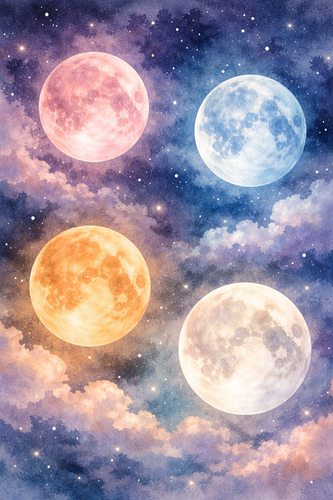
Sometimes it rises in a soft amber, almost like it’s been steeped in sunlight a little too long. Other nights, it turns pale and distant, a quiet blue-gray that feels colder than it should. And then there are those rare moments; brief, almost accidental, when it blushes. A subtle pink, a deep copper, even a faint violet if the air holds just the right mix of dust and light.For a long time, we assumed that was the whole story, that the Moon itself was mostly gray, and the colors were just tricks of the atmosphere. But recent images from Artemis program have quietly shifted that perception. Enhanced photographs of the lunar surface reveal something unexpected: mineral-rich regions glowing in subtle blues, rusty oranges, even hints of green. Titanium-rich areas reflecting cooler tones, iron deposits warming others. The Moon, it turns out, has always been holding color... it just took us time (and better eyes) to see it.
That detail feels oddly poetic.
Because in a way, someone had already imagined it.
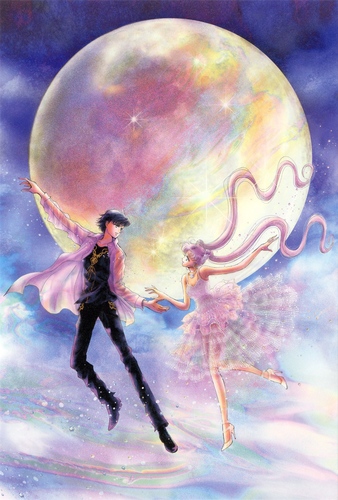
Science catches up in its own way.
And still, what we see is never just the Moon itself. It’s the Moon filtered through distance, through atmosphere, through whatever is suspended between it and us. In that sense, the colors are always a collaboration between the object, the environment, and the observer.
That idea stays with me.
Because it’s not so different from how we experience anything, really. We think we’re observing something as it is, when in reality, we’re seeing it through layers, of memory, mood, context, even the invisible conditions of the moment. The Moon just makes that visible.
If you’ve ever watched it long enough, you’ll notice how slow the changes are. Almost imperceptible. A shift in tone, a softening at the edges, a gradual fade into darkness. It asks for patience. It rewards stillness.
And maybe that’s why it feels so natural to paint it.
Watercolor, especially, mirrors that same quiet unpredictability. You don’t fully control it; you guide it, you suggest, you let the water carry pigment where it wants to go. Colors blend in ways you didn’t plan, edges dissolve, shapes breathe. It’s less about capturing the Moon exactly, and more about translating the feeling of looking at it. What you think you see, what you feel you see.
What color is the Moon to you, tonight?
Not the “correct” one. The one you actually see.
If you ever feel like exploring that, no pressure, no noise, just color and observation. I sometimes hold quiet watercolor sessions over Cafetalk. They’re simple spaces, really. Just time, paper, and the chance to sit with something as vast and as subtle as the Moon.


コメント (0)