
 English
 日本語
日本語
 한국어
한국어
 简体中文
简体中文
 繁體中文
繁體中文
 Italiano
 español
 Deutsch
 Русский


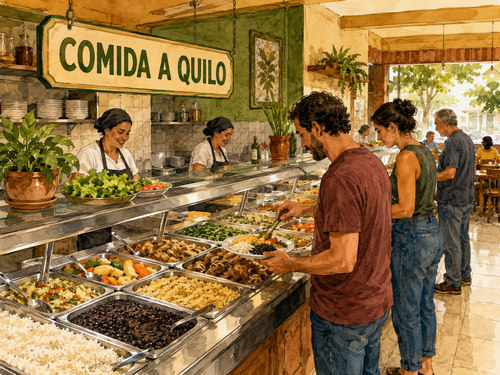
What is a “comida a quilo” restaurant?
A restaurante de comida a quilo, also called a restaurante por quilo, usually has a large buffet with several dishes.
Instead of ordering one meal from a menu, customers can create their own plates.
You may choose a little rice, a lot of salad, some meat, vegetables, pasta, farofa—or any combination you like.
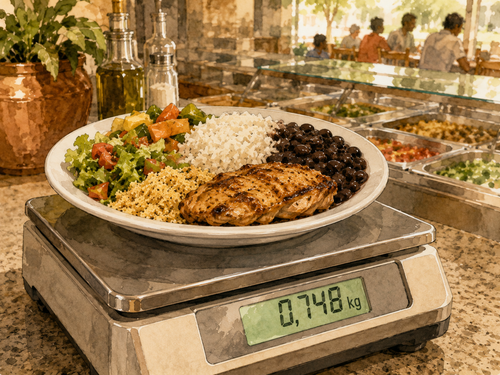
The restaurant displays a price for one kilogram of food. However, your plate does not need to weigh one kilogram. You only pay for the amount you choose.
For example, if your plate weighs 400 grams, you pay for 400 grams of food.
The weight of the empty plate is normally deducted by the restaurant’s scale.
How does it work?
The process is usually simple:
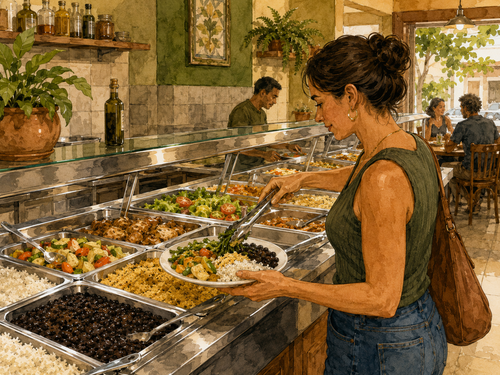
- You take a plate.
- You walk along the buffet.
- You serve yourself.
- An employee weighs your plate.
- You pay immediately or when you leave, depending on the restaurant.
Some restaurants give customers a small card or electronic command called a comanda. The price of the meal is registered on it, and the customer pays at the end.
Others weigh the plate and charge the customer before they sit down.
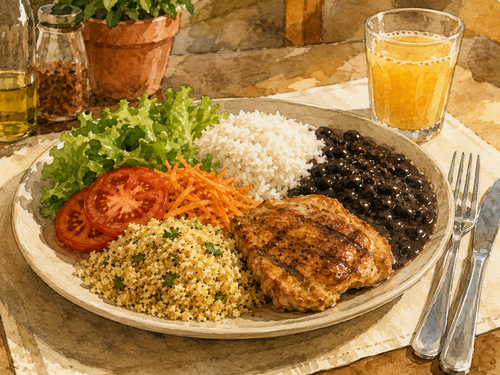
What food can you find?
The selection varies according to the restaurant and the region of Brazil.
Common options include:
- arroz — rice
- feijão — beans
- salada — salad
- legumes — vegetables
- batata — potato
- macarrão — pasta
- farofa — toasted cassava flour
- frango — chicken
- carne — meat
- peixe — fish
- ovo — egg
- sobremesa — dessert
Many restaurants offer simple dishes that resemble Brazilian home cooking, or comida caseira.
You can often find the classic combination of arroz e feijão, together with meat, vegetables and salad.
There may also be regional dishes, grilled food, Japanese food, pasta, soups and desserts.
Why are these restaurants so popular?
Comida a quilo restaurants are particularly popular during the working week.
They are often found near offices, universities, hospitals, shopping centres and busy commercial streets.
One reason for their popularity is variety. People with different preferences can eat together while choosing completely different meals.
They are also convenient. You do not need to wait for the kitchen to prepare your order, and you can control how much food goes onto your plate.
For someone who only wants a light lunch, it is possible to take a small portion. Someone who is very hungry can prepare a larger plate.
The final price, however, depends on both the restaurant’s price per kilogram and the weight of the food.
Useful Portuguese vocabulary
Here are some words you may see or hear in a comida a quilo restaurant:
comida a quilo — food sold by weight
restaurante por quilo — restaurant where food is sold by weight
self-service — self-service buffet
buffet — buffet
prato — plate
bandeja — tray
balança — scale
peso — weight
quilo — kilogram
grama — gram
comanda — a card or electronic record used to register your purchases
se servir — to serve yourself
pesar o prato — to weigh the plate
comida caseira — homemade-style food
acompanhamento — side dish
sobremesa — dessert
Useful phrases
Here are a few sentences that can help you:
Quanto custa o quilo?
How much is the price per kilogram?
É comida a quilo ou preço fixo?
Is it food by weight or a fixed price?
Posso me servir?
Can I serve myself?
Onde eu peso o prato?
Where do I weigh my plate?
A sobremesa também é por quilo?
Is the dessert also sold by weight?
Onde eu pago?
Where do I pay?
An important difference
Do not confuse comida a quilo with rodízio.
At a comida a quilo restaurant, you pay according to the weight of your food.
At a rodízio, you usually pay a fixed price and can eat several portions brought to your table.
Some restaurants also offer buffet livre, which means that you pay a fixed price and can serve yourself without weighing the plate.
Therefore, it is useful to ask:
É por quilo ou buffet livre?
Is it sold by weight or is it an all-you-can-eat buffet?
More than a place to eat
A comida a quilo restaurant is not a formal tourist attraction. It is part of ordinary Brazilian life—and that is exactly what makes it culturally interesting.
It shows how people eat during their lunch break, how Brazilian meals are organised and which foods appear together on the same plate.
It is also a useful place to practise Portuguese in a real-life situation.
You can read the names of the dishes, ask questions, talk to the employees and discover new ingredients.
Learning a language is not only about grammar. It is also about understanding everyday habits.


コメント (0)