English
 日本語
 한국어
 简体中文
 繁體中文
 Italiano
 español
 Deutsch
 Русский

Descrizioni
In programming, integers, floats, and doubles are called data types.
They are used to represent different kinds of numerical values.
Data type
What it stores
Example in Java
int
Whole numbers without decimal points
int age = 25;
float
Decimal numbers with single precision
float price = 9.99f;
double
Decimal numbers with double precision
double pi = 3.14159265;
In simple terms
-
Integer (int): Stores whole numbers, such as 10, -5, or 100.
-
Float (float): Stores decimal numbers, such as 3.14 or 7.5. In Java, you must add f at the end of a float literal, like 3.14f.
-
Double (double): Stores decimal numbers with greater precision than float. It is the default type for decimal literals in Java.
Java example
Remember: These are all primitive data types in Java.
Other primitive data types include byte, short, long, char, and boolean.
Java Data Types: A Beginner-
Friendly Lesson
Let's learn Java data types step by step, with simple explanations, examples, and practice exercises.
1. What are data types in Java?
A data type tells Java what kind of value a variable can store, such as a whole number, a decimal number, a character, or a true/false value.
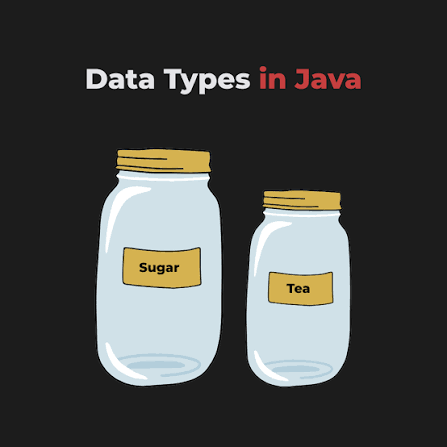
Think of variables as boxes. Each box stores a particular kind of information, and the data type tells Java what kind of information belongs in that box.
int age = 20;
A box for a whole number.
double price = 19.99;
A box for a decimal number.
char grade = 'A';
A box for one character.
2. The two main categories of Java data types
Java data types are commonly divided into two categories.
A. Primitive data types
These are Java's eight built-in data types. They store simple values directly.
Type
Stores
Example
byte
Small whole numbers
byte n = 100;
short
Short whole numbers
short n = 1000;
int
Whole numbers
int n = 25;
long
Large whole numbers
long n = 900000L;
float
Decimal numbers
float n = 3.5f;
double
More precise decimals
double n = 3.14159;
char
One UTF-16 code unit
char c = 'A';
boolean
true or false
boolean b = true;
Modalità di cancellazione di questo tutor
Prima che la richiesta sia confermata (fissata)
- La cancellazione è possibile in qualsiasi momento.
Dopo che la richiesta sia stata confermata (fissata)
- Più di 24 ore prima dell'inizio della lezione.→ La cancellazione è possibile in qualsiasi momento.
- Meno di 24 ore prima dell'inizio della lezione→ Il tutor potrebbe richiedere una penale per la cancellazione.
-
No-Show→ Il tutor potrebbe richiedere una penale per la cancellazione. Si prega di controllare i dettagli del tutor.
(Si prega di controllare i dettagli del tutor.)
Le sue lezioni
-
What If? Unlock the Power of the 4 English Conditionals!
Learn how to talk about facts, possibilities, dreams, and regrets using the Zero, First, Second, and Third Conditionals—with simple rules, real-life examples, and fun practice!English
 30min 1,100P