
 English
 日本語
日本語
 한국어
한국어
 简体中文
简体中文
 繁體中文
繁體中文
 Italiano
 español
 Deutsch
 Русский


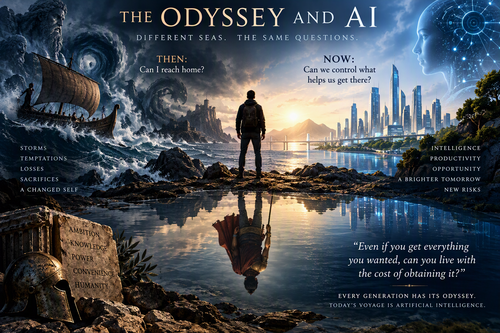
Most people remember The Odyssey as a story about success.
After twenty years of war, shipwrecks, monsters, temptations, and loss, Odysseus finally returns home. The hero completes his quest. The story ends, and the audience is meant to celebrate.
Or does it?
What makes many Greek stories endure is that they refuse to give us a simple fairy-tale ending. The quest may be victorious, but victory itself comes with consequences. Odysseus returns home, yet he is no longer the man who left. He has lost friends, years of his life, and parts of himself. The prize is gained, but the cost remains.
This is why Greek mythology often feels surprisingly modern. It understands something that many success stories leave out: achieving your goal does not end the story.
There is always another chapter.
A promotion might bring stress. Wealth might bring isolation. Fame might attract attention that becomes difficult to escape. Even the fulfillment of our deepest ambitions can create new problems that did not exist before.
Success is rarely free.
Perhaps the deeper question hidden within The Odyssey is not:
"Can you get what you want?"
Rather, it is:
"Can you live with the cost of obtaining it?"
This ancient question may be more relevant today than ever, particularly when we think about artificial intelligence.
Much of the discussion surrounding AI focuses on what the technology can do. Can it write? Can it diagnose medical conditions? Can it automate jobs? Can it solve scientific problems? Can it create art, code, or business strategies?
These are important questions, but they are not the only questions.
As AI becomes increasingly capable, humanity may find itself in the position of Odysseus. We are pursuing a goal that promises enormous rewards: greater productivity, greater knowledge, and greater convenience.
But every powerful tool carries a price.
If AI eliminates tedious work, what happens to the skills we stop practicing?
If AI makes decisions faster than humans, what happens to human judgment?
If AI becomes our primary source of information, what happens to our ability to think independently?
The challenge is not simply building intelligent machines. The challenge is preserving the qualities that make us human while doing so.
That is why the most important question about AI may not be technological at all.
It is philosophical.
Even if AI helps us achieve everything we want, can we live with the cost?
Like Odysseus standing on the shores of Ithaca after a journey that changed him forever, humanity may one day arrive at its destination and discover that the real story was never about reaching the goal. It was about who we became along the way.
The future of AI, like every great quest, will not be judged solely by its achievements.
It will be judged by what those achievements cost us, and whether the reward was worth the price.
After all, getting everything you wanted is not the same as keeping everything that mattered.


응답 (0)