
 English
 日本語
 한국어
 简体中文
 繁體中文
 Italiano
 español
 Deutsch
 Русский


Three minutes into a Tuesday morning stand-up, you can usually tell who is going to win the room and who is going to lose it.
It rarely comes down to who has the best English grammar. I spent years leading enterprise data teams in Hong Kong, sitting across from brilliant software engineers, database architects, and analysts who could debug a broken production pipeline in twenty minutes flat. Yet the moment they had to explain that exact fix to a product manager or an executive in English, the wheels came off.
They didn't fail because they lacked technical skill. They failed because they told the story backward.
In engineering, we are trained to think linearly. You look at the logs, trace the error, inspect the schema, rewrite the query, and test the output. Naturally, when a manager asks,"What happened with the database migration?", an engineer starts at step one. Five minutes later, they are still explaining table joins and server latency while the executives in the room are checking their phones.
In Western corporate culture—especially in fast-moving tech environments—audiences don't want a mystery novel. They want the headline first, followed by a clean, structured path from problem to business impact.
That is where the STAR Method comes in. Most people think of STAR as a rigid formula for job interviews, but in reality, it is the cleanest framework you can use for status updates, project post-mortems, and presentation slides.
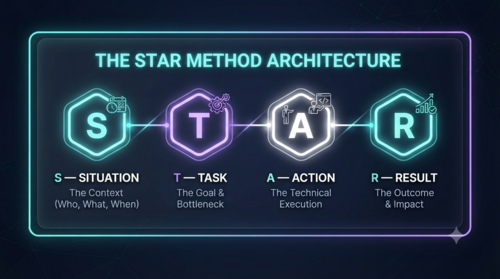
Here is how it works when you strip out the textbook fluff:
-
S — Situation (The Context): Set the scene in one or two plain sentences. What system, client, or deadline was involved? Skip the backstory from six months ago.
-
T — Task (The Bottleneck): What broke, or what specific target did you need to hit? Define the friction clearly so non-technical listeners understand why it mattered.
-
A — Action (The Execution): What did you actually do? Keep this focused on the key decision or technical pivot—not every line of code you touched.
-
R — Result (The Payoff): What changed because of your work? Use numbers whenever you can: hours saved, error rates dropped, revenue protected.
Look at the difference in how that sounds in a live meeting:
The "Log-File" Version (Too much detail, lost audience):
"Well, on Monday the cron job failed because the upstream API changed a field name, so the ingestion script threw a null error. I had to check the staging logs, update the Python parser, rebuild the schema mapping, and re-run the batch..."
The STAR Version (Clear, executive-ready):
"On Monday, an upstream API change broke our daily data sync (Situation), which put our morning sales dashboard at risk (Task). I updated the ingestion parser and added an automated schema check to catch field changes early (Action). As a result, we restored the pipeline within an hour with zero missing records (Result)."
Notice that the second version doesn't use fancy vocabulary or complex idioms. The English is straightforward. What changed is the architecture of the explanation. Every sentence has a job, and the listener knows within twenty seconds why the work mattered.
The next time you prepare for an English meeting, a slide presentation, or a technical interview, don't memorize a word-for-word script. Just map out four bullet points—S, T, A, and R—on a sticky note next to your monitor. When you control the structure, your fluency takes care of itself.
Have an upcoming presentation, status update, or technical interview you want to tighten up? Bring your real project notes into one of my Business & Tech English or Quick Sounding Board sessions below—we’ll turn your technical work into clear, confident English.


응답 (0)