English
 日本語
日本語
 한국어
한국어
 简体中文
简体中文
 繁體中文
繁體中文
 Italiano
 español
 Deutsch
 Русский

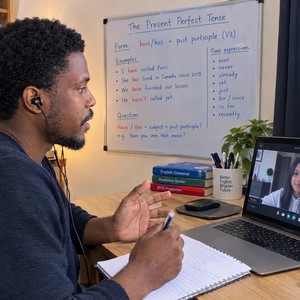
Kursinhalt
French Sample Lesson: Ordering at a French Café
Level: Beginner (A1)
Duration: 60 minutes
Topic: Ordering food and drinks at a French café
Main Goal: By the end of the lesson, students will be able to confidently order a drink or food item in French, ask for the price, and respond appropriately in a simple café conversation.
Learning Objectives
By the end of the lesson, students will be able to:
- Recognize and use common café vocabulary.
- Use polite expressions such as “Je voudrais…” and “S’il vous plaît.”
- Ask and answer “C’est combien ?”
- Create and perform a short café dialogue.
- Improve their French pronunciation and confidence through speaking practice.
1. Welcome & Warm-Up – 5 minutes
Start with a friendly greeting:
Teacher:
“Bonjour ! Comment allez-vous aujourd’hui ?”
Ask a few simple questions to create interaction:
- “Comment vous appelez-vous ?”
- “Vous aimez le café ?”
- “Qu’est-ce que vous aimez boire ?”
Encourage participation and correct gently.
Use positive feedback such as:
- “Très bien !”
- “Excellent effort !”
- “Don't worry about making mistakes — that's how we learn.”
Briefly introduce the lesson:
“Today, we're going to learn how to order food and drinks in a French café. By the end of the lesson, you'll be able to make your own order in French.”
2. Café Vocabulary – 7 minutes
Introduce useful vocabulary using pictures or visual examples.
Drinks
- un café – coffee
- un thé – tea
- un chocolat chaud – hot chocolate
- un jus d’orange – orange juice
- une eau – water
- une bouteille d’eau – bottle of water
Food
- un croissant
- un sandwich
- un gâteau
- une salade
- une crêpe
Check understanding with simple questions:
“Qu’est-ce que c’est ?”
“What is this?”
Ask the student to repeat each word and pay attention to pronunciation.
Use encouragement:
“Très bien ! Excellent effort!”
3. Key Expressions – 8 minutes
Introduce the most important expressions for ordering.
Ordering
“Je voudrais…”
= I would like…
Examples:
- “Je voudrais un café, s’il vous plaît.”
- “Je voudrais un croissant, s’il vous plaît.”
- “Je voudrais un jus d’orange, s’il vous plaît.”
Other useful expressions
“Bonjour.” – Hello
“S’il vous plaît.” – Please
“Merci.” – Thank you
“Avec plaisir.” – With pleasure
“C’est combien ?” – How much is it?
“Bonne journée !” – Have a nice day!
Ask the student to repeat the expressions and then create one original sentence.
Ask a comprehension question:
“Can you tell me why we use ‘je voudrais’ here?”
Guide the student toward the idea that “je voudrais” is a polite way to say what they would like.
4. Building a Complete Order – 5 minutes
Model a short exchange:
Serveur: Bonjour !
Client: Bonjour ! Je voudrais un café, s’il vous plaît.
Serveur: Bien sûr.
Client: Merci.
Serveur: Avec plaisir !
Then ask the student to create their own order.
For example:
“Je voudrais un thé et un croissant, s’il vous plaît.”
Correct pronunciation and grammar naturally.
If the student struggles:
“Almost! Let’s try that again together.”
5. Asking About the Price – 5 minutes
Teach:
“C’est combien ?”
Example:
Client: Je voudrais un café, s’il vous plaît.
Serveur: Bien sûr.
Client: C’est combien ?
Serveur: Trois euros.
Practice several variations.
Then increase the challenge:
“Now I'm going to make it a little more challenging.”
Ask the student to combine the skills:
- Order a drink.
- Order a food item.
- Ask the price.
- Thank the server.
6. Short Break / Transition – 5 minutes
Allow a short break or relaxed transition.
Before continuing:
“Très bien ! You're doing great. Now let's put everything together in a real café situation.”
7. Listening & Comprehension – 5 minutes
Read or act out a short café dialogue.
Serveur: Bonjour !
Client: Bonjour ! Je voudrais un chocolat chaud et un croissant, s’il vous plaît.
Serveur: Bien sûr.
Client: C’est combien ?
Serveur: Cinq euros.
Client: Merci !
Serveur: Avec plaisir.
Ask simple comprehension questions:
- “What did the customer order?”
- “How much did it cost?”
- “What expression did the customer use to ask for the price?”
Praise correct answers and clarify anything unclear.
8. Role-Play – 8 minutes
Now create a realistic café situation.
Round 1
Teacher = Server
Student = Customer
The student must:
- Greet the server.
- Order a drink.
- Order food.
- Ask the price.
- Say thank you.
Encourage natural conversation rather than simply reading from a script.
Give feedback after the role-play.
Round 2
Switch roles.
Student = Server
Teacher = Customer
This gives the student an opportunity to understand both sides of the conversation.
If appropriate, introduce a small challenge, such as asking:
“Et avec ça ?”
Then encourage the student to respond.
9. Final Challenge – 2 minutes
Give the student a final independent task:
“Imagine you're visiting a café in France. Make your complete order without looking at the notes.”
The student should include:
- A greeting
- “Je voudrais…”
- A food or drink
- “S’il vous plaît”
- “C’est combien ?”
- “Merci”
Give supportive feedback:
“Excellent effort! You used the expressions correctly.”
If there is a mistake:
“Don't worry about making mistakes — that's how we learn. Let's try it one more time.”
10. Review & Assessment – 5 minutes
Quickly review the key vocabulary and expressions.
Ask:
“What are three things you can now say in a French café?”
Expected examples:
- “Je voudrais…”
- “S’il vous plaît.”
- “C’est combien ?”
- “Merci.”
Finish positively:
“Très bien ! Today you learned how to order food and drinks, ask about the price, and have a simple café conversation in French.”
Final Encouragement
“Excellent work today! You communicated in French, practiced pronunciation, and handled a real-life situation. Keep practicing these expressions, and you'll become more confident speaking French.”
Teaching Approach Demonstrated
Throughout the lesson, I use a student-centered and interactive approach. I introduce vocabulary clearly, model useful language, check understanding, encourage the student to produce their own sentences, and gradually increase the difficulty.
I also use positive correction rather than interrupting unnecessarily. When a student makes a mistake, I guide them toward the correct answer and give them another opportunity to use the language independently.
Key teacher phrases include:
- “Très bien !”
- “Excellent effort!”
- “Almost! Let’s try that again together.”
- “Can you tell me why we use ‘je voudrais’ here?”
- “Now I'm going to make it a little more challenging.”
- “Don't worry about making mistakes — that's how we learn.”
Rücktrittsregelung der/des TutorIn
This lesson is “Immediately Confirmed”
If the requested date falls within 30 days, the request will be “confirmed” immediately without having to wait for the tutor to reply.
The policy “before request is confirmed” will not apply to requests that are confirmed immediately.
Vor der Bestätigung einer Kursbuchung
- Stornierung jederzeit möglich
Nach der Bestätigung einer Kursbuchung
- Mehr als 24 Stunden vor Kursbeginn→ Stornierung jederzeit möglich
- Weniger als 24 Stunden vor Kursbeginn→ Stornogebühren können anfallen.
-
No-Show→ Stornogebühren können anfallen.
(Der Betrag kann je nach TutorIn variieren. Bitte nimm Kontakt mit Deiner Tutorin/ Deinem Tutor auf.)
Alle Kurse von dieser/m TutorIn
-
French for Real Life | Role-Play & Practical Situations
30-minute practical French lessonFrench
 Confirmed Immediately
30 Min. 1,600P
Confirmed Immediately
30 Min. 1,600P -

Speak French with Confidence | Real Conversation + Personalized Corrections
A practical 25-minute French lesson designed to help you speak more naturally, confidently, and spontaneously.French
Confirmed Immediately
25 Min. 1,700PHat Schnupperkurs -

⚡ French Speaking Boost | 10-Minute Conversation & Corrections ??
Feel stuck when you try to speak French? Let's fix one thing at a time!French
Confirmed Immediately
15 Min. 900P -

Speak French with Confidence! ?? | Practical Conversation + Corrections
25-minute personalized French conversation lesson for A1–B2 learnersFrench
Confirmed Immediately
25 Min. 1,500P