English
 日本語
日本語
 한국어
한국어
 简体中文
简体中文
 繁體中文
繁體中文
 Italiano
 español
 Deutsch
 Русский

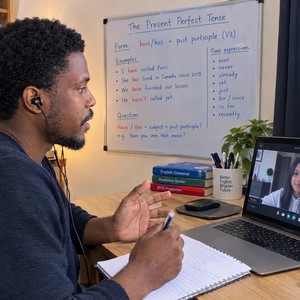
레슨 상세 내용
French Sample Lesson: Ordering at a French Café
Level: Beginner (A1)
Duration: 60 minutes
Topic: Ordering food and drinks at a French café
Main Goal: By the end of the lesson, students will be able to confidently order a drink or food item in French, ask for the price, and respond appropriately in a simple café conversation.
Learning Objectives
By the end of the lesson, students will be able to:
- Recognize and use common café vocabulary.
- Use polite expressions such as “Je voudrais…” and “S’il vous plaît.”
- Ask and answer “C’est combien ?”
- Create and perform a short café dialogue.
- Improve their French pronunciation and confidence through speaking practice.
1. Welcome & Warm-Up – 5 minutes
Start with a friendly greeting:
Teacher:
“Bonjour ! Comment allez-vous aujourd’hui ?”
Ask a few simple questions to create interaction:
- “Comment vous appelez-vous ?”
- “Vous aimez le café ?”
- “Qu’est-ce que vous aimez boire ?”
Encourage participation and correct gently.
Use positive feedback such as:
- “Très bien !”
- “Excellent effort !”
- “Don't worry about making mistakes — that's how we learn.”
Briefly introduce the lesson:
“Today, we're going to learn how to order food and drinks in a French café. By the end of the lesson, you'll be able to make your own order in French.”
2. Café Vocabulary – 7 minutes
Introduce useful vocabulary using pictures or visual examples.
Drinks
- un café – coffee
- un thé – tea
- un chocolat chaud – hot chocolate
- un jus d’orange – orange juice
- une eau – water
- une bouteille d’eau – bottle of water
Food
- un croissant
- un sandwich
- un gâteau
- une salade
- une crêpe
Check understanding with simple questions:
“Qu’est-ce que c’est ?”
“What is this?”
Ask the student to repeat each word and pay attention to pronunciation.
Use encouragement:
“Très bien ! Excellent effort!”
3. Key Expressions – 8 minutes
Introduce the most important expressions for ordering.
Ordering
“Je voudrais…”
= I would like…
Examples:
- “Je voudrais un café, s’il vous plaît.”
- “Je voudrais un croissant, s’il vous plaît.”
- “Je voudrais un jus d’orange, s’il vous plaît.”
Other useful expressions
“Bonjour.” – Hello
“S’il vous plaît.” – Please
“Merci.” – Thank you
“Avec plaisir.” – With pleasure
“C’est combien ?” – How much is it?
“Bonne journée !” – Have a nice day!
Ask the student to repeat the expressions and then create one original sentence.
Ask a comprehension question:
“Can you tell me why we use ‘je voudrais’ here?”
Guide the student toward the idea that “je voudrais” is a polite way to say what they would like.
4. Building a Complete Order – 5 minutes
Model a short exchange:
Serveur: Bonjour !
Client: Bonjour ! Je voudrais un café, s’il vous plaît.
Serveur: Bien sûr.
Client: Merci.
Serveur: Avec plaisir !
Then ask the student to create their own order.
For example:
“Je voudrais un thé et un croissant, s’il vous plaît.”
Correct pronunciation and grammar naturally.
If the student struggles:
“Almost! Let’s try that again together.”
5. Asking About the Price – 5 minutes
Teach:
“C’est combien ?”
Example:
Client: Je voudrais un café, s’il vous plaît.
Serveur: Bien sûr.
Client: C’est combien ?
Serveur: Trois euros.
Practice several variations.
Then increase the challenge:
“Now I'm going to make it a little more challenging.”
Ask the student to combine the skills:
- Order a drink.
- Order a food item.
- Ask the price.
- Thank the server.
6. Short Break / Transition – 5 minutes
Allow a short break or relaxed transition.
Before continuing:
“Très bien ! You're doing great. Now let's put everything together in a real café situation.”
7. Listening & Comprehension – 5 minutes
Read or act out a short café dialogue.
Serveur: Bonjour !
Client: Bonjour ! Je voudrais un chocolat chaud et un croissant, s’il vous plaît.
Serveur: Bien sûr.
Client: C’est combien ?
Serveur: Cinq euros.
Client: Merci !
Serveur: Avec plaisir.
Ask simple comprehension questions:
- “What did the customer order?”
- “How much did it cost?”
- “What expression did the customer use to ask for the price?”
Praise correct answers and clarify anything unclear.
8. Role-Play – 8 minutes
Now create a realistic café situation.
Round 1
Teacher = Server
Student = Customer
The student must:
- Greet the server.
- Order a drink.
- Order food.
- Ask the price.
- Say thank you.
Encourage natural conversation rather than simply reading from a script.
Give feedback after the role-play.
Round 2
Switch roles.
Student = Server
Teacher = Customer
This gives the student an opportunity to understand both sides of the conversation.
If appropriate, introduce a small challenge, such as asking:
“Et avec ça ?”
Then encourage the student to respond.
9. Final Challenge – 2 minutes
Give the student a final independent task:
“Imagine you're visiting a café in France. Make your complete order without looking at the notes.”
The student should include:
- A greeting
- “Je voudrais…”
- A food or drink
- “S’il vous plaît”
- “C’est combien ?”
- “Merci”
Give supportive feedback:
“Excellent effort! You used the expressions correctly.”
If there is a mistake:
“Don't worry about making mistakes — that's how we learn. Let's try it one more time.”
10. Review & Assessment – 5 minutes
Quickly review the key vocabulary and expressions.
Ask:
“What are three things you can now say in a French café?”
Expected examples:
- “Je voudrais…”
- “S’il vous plaît.”
- “C’est combien ?”
- “Merci.”
Finish positively:
“Très bien ! Today you learned how to order food and drinks, ask about the price, and have a simple café conversation in French.”
Final Encouragement
“Excellent work today! You communicated in French, practiced pronunciation, and handled a real-life situation. Keep practicing these expressions, and you'll become more confident speaking French.”
Teaching Approach Demonstrated
Throughout the lesson, I use a student-centered and interactive approach. I introduce vocabulary clearly, model useful language, check understanding, encourage the student to produce their own sentences, and gradually increase the difficulty.
I also use positive correction rather than interrupting unnecessarily. When a student makes a mistake, I guide them toward the correct answer and give them another opportunity to use the language independently.
Key teacher phrases include:
- “Très bien !”
- “Excellent effort!”
- “Almost! Let’s try that again together.”
- “Can you tell me why we use ‘je voudrais’ here?”
- “Now I'm going to make it a little more challenging.”
- “Don't worry about making mistakes — that's how we learn.”
이 강사의 취소 방침
이 레슨은 “자동 확정”된 레슨입니다.
리퀘스트의 스케줄이 30일 이내일 경우 리퀘스트는 강사의 확인없이 자동으로 “확정”됩니다.
자동 확정된 리퀘스트는 “확정 전 리퀘스트” 사용방침에 적용되지 않습니다.
리퀘스트 확정 전
- 언제든 취소 가능
리퀘스트 확정 후
- 레슨 시작 24시간 전→ 언제든 취소 가능
- 레슨 시작 24시간 이내→ 취소 요금이 발생할 수 있습니다.
-
노쇼→ 취소 요금이 발생할 수 있습니다.
(자세한 사항은 강사에게 문의해 주시기 바랍니다.)
이 강사의 다른 레슨
-
French for Real Life | Role-Play & Practical Situations
30-minute practical French lesson프랑스어
 자동 확정
30분 1,600P
자동 확정
30분 1,600P -

Speak French with Confidence | Real Conversation + Personalized Corrections
A practical 25-minute French lesson designed to help you speak more naturally, confidently, and spontaneously.프랑스어
자동 확정
25분 1,700P트라이얼 레슨 -

⚡ French Speaking Boost | 10-Minute Conversation & Corrections ??
Feel stuck when you try to speak French? Let's fix one thing at a time!프랑스어
자동 확정
15분 900P -

Speak French with Confidence! ?? | Practical Conversation + Corrections
25-minute personalized French conversation lesson for A1–B2 learners프랑스어
자동 확정
25분 1,500P